
Hours of Sleep: How Long Is Too Little or Too Much?
TL;DR
Most adults need enough sleep to feel alert and function well—too little raises health risks, and too much can signal underlying issues. Clock hours alone don’t tell the full story: sleep quality, consistency, and the absence of disruptions matter just as much. If you wake unrefreshed, snore loudly, or notice other problems, consider a professional evaluation. Good sleep hygiene supports healthier, more restorative rest.

On average, adults need 7-9 hours of sleep every night to stay healthy unless you are a short sleeper (or sleepless elite).[8]
As a short sleeper, he/she has an easy time falling asleep and only needs four to five hours of sleep each night to feel well-rested and alert. However, to be an elite sleeper is, for the most part, genetic and scientists estimate they make up only about 1% of the population.
If Sleep Too Little
Adults who slept 5 hours or less a night had a 15% greater mortality risk compared with those sleeping 7 hours.
As we know, too little sleep may fuel insulin resistance
- Sleep deficiency results in a higher than normal blood sugar level, which may increase your risk for diabetes[2]
- After four nights of sleep deprivation (sleep time was only 4.5 hours per night), study participants' insulin sensitivity was 16 percent lower, while their fat cells' insulin sensitivity was 30 percent lower, and rivaled levels seen in those with diabetes or obesity[3]
- Researchers at the University of Chicago found that losing just 3 to 4 hours of sleep over a period of several days is enough to trigger metabolic changes that are consistent with a prediabetic state.[4]
- Scientists in Japan have found that middle-aged Japanese who got 4 hours of sleep or less had roughly a 50% greater likelihood of dying from a stoke.[9]
- In a recent study of 150,000 Americans, higher stoke rates were found among individuals sleeping 6 hours or less.[10]

If Sleep Too Much
While not getting enough sleep is clearly associated with increased health risks, so is getting too much sleep:
- Those who slept 9 hours had a 42% increase in mortality risk.[5]
- Middle-aged Japanese who slept 10 hours or more had higher risk of dying from a stroke.[9]
- Americans who slept 9 hours or more had higher stroke rate.[10]
Every person is unique. Hours of sleep needed for each is different and varies with age. See above diagram for the recommended sleep hours per your age.
Besides hours of sleep, there are other factors to consider to get a good night sleep, read [1] for some recommendations. With a good night sleep, hopefully, you will wake up feeling energized and refreshed everyday. Stay healthy!
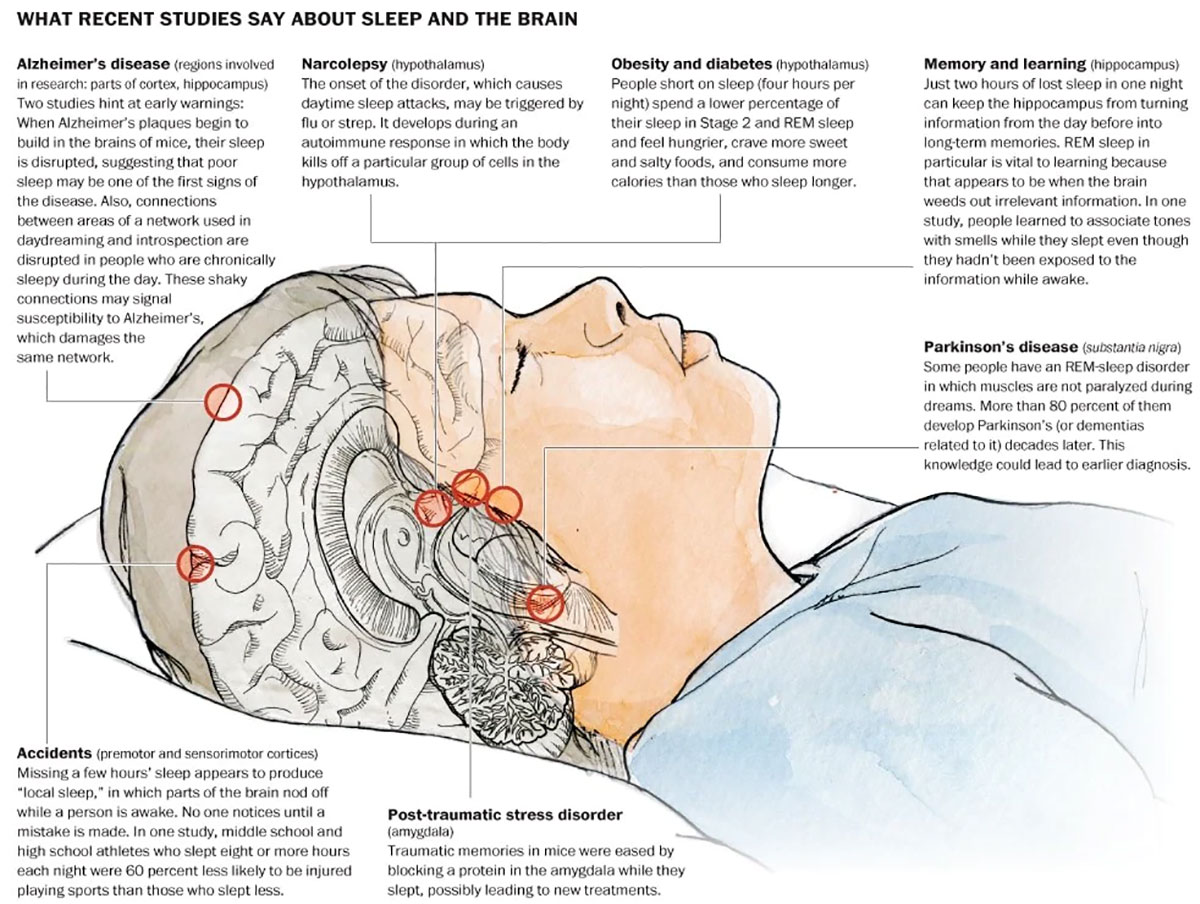
Image via: AHealthBlog
Caveats
Sleep isn’t just about the number of hours on the clock. Focusing solely on duration can overlook issues with sleep quality, sleep consistency, and sleep disruptions that meaningfully affect how rested you feel.
Healthy sleep should be:
- Sufficient in duration — long enough for your body’s needs.
- Restorative in quality — you wake feeling refreshed, not groggy.
- Reasonably consistent in timing — stable bed/wake times support circadian rhythms.
- Free of major disruptions or disorders — such as loud snoring, gasping, or repeated awakenings.
- Supportive of good daytime functioning — alertness, mood, and concentration should feel normal.
If you consistently feel unrested, notice loud snoring or gasping, or have other concerns, consider discussing them with a healthcare professional. Even simple screening or a formal sleep evaluation can clarify what’s going on.
References
- Enjoy Good Night Sleep and Live Longer (Travel and Health)
- Diabetes and the Night Shift Factor
- Impaired Insulin Signaling in Human Adipocytes After Experimental Sleep Restriction: A Randomized, Crossover Study (Annals of Internal Medicine)
- Knutson, K. L. (2007). Impact of sleep and sleep loss on glucose homeostasis and appetite regulation. Sleep Medicine Clinics, 2(2), 187–197.
- Growing Number of People Get Too Much Sleep
- HOW MUCH SLEEP DO WE REALLY NEED?
- sleep.org
- Here's why a 'sleepless elite' needs just 4 hours of sleep a night
- Ikehara, S., Iso, H., Date, C., Kikuchi, S., Watanabe, Y., Wada, Y., Inaba, Y., & Tamakoshi, A. (2009). Association of sleep duration with mortality from cardiovascular disease and other causes for Japanese men and women: The JACC study. Sleep, 32(3), 295–301.
- Fang, J., Wheaton, A. G., & Ayala, C. (2014). Sleep duration and history of stroke among adults from the USA. Journal of Sleep Research, 23(5), 531–537.
- Ramar, K., Malhotra, R. K., Carden, K. A., Martin, J. L., Abbasi-Feinberg, F., Aurora, R. N., Kapur, V. K., Olson, E. J., Rosen, C. L., Rowley, J. A., Shelgikar, A. V., & Trotti, L. M. (2021). Sleep is essential to health: An American Academy of Sleep Medicine position statement. Journal of Clinical Sleep Medicine, 17(10), 2115–2119.
- Emphasizes that healthy sleep requires adequate duration plus good quality, appropriate timing, regularity, and the absence of sleep disorders; supports evaluating symptoms and promoting behaviors that foster these dimensions.
- Windred, D. P., Burns, A. C., Lane, J. M., Saxena, R., Rutter, M. K., Cain, S. W., & Phillips, A. J. K. (2024). Sleep regularity is a stronger predictor of mortality risk than sleep duration: A prospective cohort study. Sleep, 47(1), zsad253.
- Large objective actigraphy study showing sleep regularity/consistency is a stronger predictor of mortality risk than duration alone, supporting the need to look beyond total hours.
- Irish, L. A., Kline, C. E., Gunn, H. E., Buysse, D. J., & Hall, M. H. (2015). The role of sleep hygiene in promoting public health: A review of empirical evidence. Sleep Medicine Reviews, 22, 23–36.
- Reviews evidence for sleep hygiene components such as consistent schedules, limiting caffeine/alcohol, managing the sleep environment [noise/light], and related practices that support quality, timing, and overall restorative sleep.
- Watson, N. F., Badr, M. S., Belenky, G., Bliwise, D. L., Buxton, O. M., Buysse, D., Dinges, D. F., Gangwisch, J., Grandner, M. A., Kushida, C., Malhotra, R. K., Martin, J. L., Patel, S. R., Quan, S. F., & Tasali, E. (2015). Recommended amount of sleep for a healthy adult: A joint consensus statement of the American Academy of Sleep Medicine and Sleep Research Society. Sleep, 38(6), 843–844.


Comments
Post a Comment